
Regulatory Analysis · May 2026
Minnesota Criminalises Prediction Markets. The Federal Government Sued the Next Day.
On May 18, 2026, Minnesota became the first US state to make operating a prediction market a felony. Within 24 hours, the CFTC filed suit to block it. The Aug 1 effective date is approaching, and no injunction has been granted.
Published: May 2026 | Last reviewed: May 2026
- › Minnesota SF4760, signed May 18, 2026, makes it a felony to operate, facilitate, or advertise a prediction market in the state. Penalties reach five years in prison and a $10,000 fine. Users themselves face no criminal punishment.
- › The CFTC sued within 24 hours, seeking a preliminary injunction before the Aug 1 effective date. The agency characterised the law as the most aggressive state action against federally regulated markets in the Commodity Exchange Act's 50-year history.
- › The law is broader than any prior state effort: it criminalises weather-related event contracts, which the CFTC says farmers have relied on for decades, and explicitly covers advertising and facilitation, not only direct operation.
- › Kalshi and Polymarket remain available in Minnesota as of publication. Whether they remain available past Aug 1 depends entirely on whether a court grants the injunction before that date. No ruling has been issued.
- › The core dispute — does the Commodity Exchange Act pre-empt state criminal gambling law? — is constitutionally significant. It has produced conflicting outcomes across six state lawsuits so far, and Minnesota now sets the highest stakes yet.
What SF4760 Actually Says
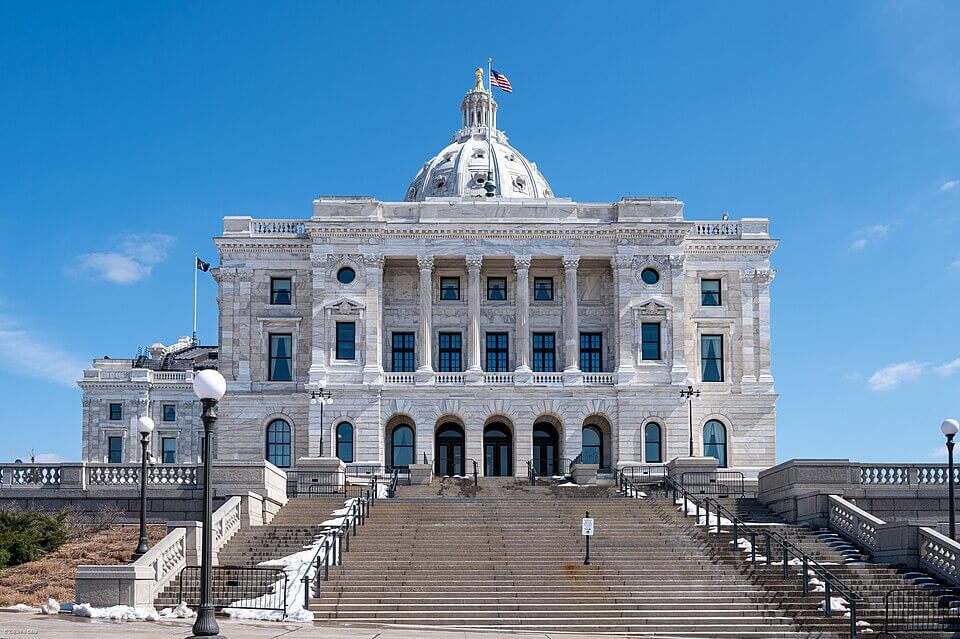
Minnesota SF4760 is an omnibus public safety bill, and the prediction market ban is contained within it rather than standing as its own legislation. That matters for context: the bill passed the Minnesota House 100-32 and the Senate 57-9, reflecting broad bipartisan support for the package as a whole. Whether those margins reflect broad agreement on the prediction market provisions specifically is a separate question.
The operative provisions make it a felony to create, operate, or intentionally facilitate a prediction market for consideration, if done as part of a business. Advertising and promotion of a prediction market within Minnesota is also covered. The criminal classification is significant: this is not a civil regulatory action or a cease-and-desist. It is a state criminal statute, with penalties reaching five years in prison and a $10,000 fine per violation.
The law defines prediction markets broadly as systems allowing wagers on the outcome of future events, covering sports, elections, government actions, weather, public health crises, armed conflicts, and popular culture. This is a wider scope than most prior state efforts, which tended to focus on political event contracts or sports outcomes. The broader the definition, the more it captures CFTC-regulated instruments, and the stronger the preemption argument becomes.
| Provision | Detail |
|---|---|
| Criminal classification | Felony for operating, facilitating, or advertising a prediction market as part of a business |
| Penalties | Up to five years in prison and a $10,000 fine per violation |
| User liability | Bettors and individual users face no criminal punishment under the law |
| Scope | Sports, elections, government actions, weather, public health crises, armed conflicts, popular culture |
| Effective date | August 1, 2026 |
| Enforcement tools | Authorises cease-and-desist orders and court enforcement actions in addition to criminal prosecution |
Source: Minnesota SF4760, signed May 18, 2026. Minnesota Legislature — revisor.mn.gov.
The law also amends existing Minnesota statutes governing commodities contracts, removing a prior exemption that prediction market operators had argued applied to their instruments. That amendment closes what had been a potential defence and signals that the legislature was aware of the federal preemption argument and sought to address it directly within state law.
The CFTC's Preemption Argument
The CFTC filed its lawsuit on May 19, 2026, the day after Governor Walz signed the bill. The agency is seeking declaratory and injunctive relief against the state, the Governor, Attorney General Keith Ellison, and Minnesota's gambling regulators. It is asking a federal court to issue a preliminary injunction before the Aug 1 effective date.
The central legal argument is federal preemption under the Commodity Exchange Act. The CFTC's position is that Congress granted the agency exclusive jurisdiction over event contracts traded on CFTC-registered exchanges, and that a state cannot override that federal framework through criminal law. The complaint describes Kalshi and other registered platforms as Designated Contract Markets operating lawfully under federal oversight, and characterises the Minnesota statute as an attempt to nullify a federal regulatory regime.
CFTC Chairman Michael Selig issued a public statement calling the Minnesota law the most aggressive state action the commission had encountered, and said it "turns lawful operators and participants in prediction markets into felons overnight." The characterisation of users as potential felons is technically inaccurate on the law's face, which exempts individual bettors, but it reflects the CFTC's position that anyone who partners with, facilitates, or advertises these exchanges is exposed.
Source: CFTC press release 9233-26, May 19, 2026 — cftc.gov/PressRoom/PressReleases/9233-26
The lawsuit also carries a political dimension. The CFTC under Chair Selig has been substantially more permissive toward prediction markets than its Biden-era predecessor, and the commission has now filed suits against six states. There is an inherent tension in a federal regulator appointed by one administration suing Democratic-led states to protect an industry closely associated with both Republican political fundraising and the current president's allies. The commission's legal arguments are distinct from these political dynamics, but they are not separable from the public debate.
Source: Reuters, May 19, 2026; CFTC complaint, CFTC v. State of Minnesota et al., D. Minn. (May 19, 2026).
The Weather Carve-Out — and Why the CFTC Objects Anyway
One of the more consequential aspects of SF4760 is that the legislature amended the bill before passage to carve out certain weather-related activity. This followed pressure from Minnesota's agricultural industry, whose members have historically used weather futures and related instruments to hedge against storm losses, drought, and harvest disruptions.
The law's exceptions cover contracts that function as insurance or indemnity against harm or loss, and contracts for the purchase or sale at a future date of securities or other commodities. The intent appears to be protecting traditional agricultural hedging. However, the CFTC's position, and this is the key point, is that those carve-outs do not adequately protect the event contracts that weather-focused prediction market traders actually use on CFTC-registered exchanges.
Selig's statement emphasised this point directly, framing the lawsuit as a defence of farmers rather than of prediction market platforms. Whether that framing is persuasive to a federal court is a separate question, but it shapes the public narrative around the case.
Source: NPR, May 19, 2026 — npr.org; CFTC press release 9233-26 — cftc.gov; CBS Minnesota, May 19, 2026 — cbsnews.com.
The Political Context
The CFTC's aggressive posture on prediction markets under the current administration does not exist in a political vacuum. Donald Trump Jr. serves as an adviser to both Kalshi and Polymarket, and the Trump media organisation launched its own prediction market product in 2025. That product has since been scaled back, but the commercial and political connections between the current administration's allies and the prediction market industry are documented.
This creates an observable pattern: a federal regulator, operating under an administration with financial ties to the industry, is suing Democratic-led states that have sought to restrict it. Senator Elizabeth Warren noted in February 2026 that the CFTC was "trying to strip states of their authority to regulate gambling within their borders," framing the commission's pre-emption strategy as politically motivated.
This analysis does not render the CFTC's legal arguments invalid. The Commodity Exchange Act's pre-emption provisions predate the current administration and have been consistently applied. Federal courts have split on whether those provisions apply to state gambling enforcement. But for B2B readers trying to understand why the federal government is suing a state over a felony gambling statute with substantial public support, the political context is relevant and documented.
Sources: Minnesota Reformer, May 19, 2026 — minnesotareformer.com; Sen. Warren press release, Feb 17, 2026 — warren.senate.gov; Salon, May 24, 2026 — salon.com.
What It Means for Kalshi and Polymarket
Kalshi, the largest US prediction market operator and a CFTC Designated Contract Market, is the platform most directly affected. It currently remains available to Minnesota users. The question is whether it will withdraw or be forced to withdraw before Aug 1 if no injunction is issued.
Kalshi's public response has been pointed. Spokesperson Elisabeth Diana said the Minnesota ban was comparable to banning the NYSE, and that it would drive activity offshore and reduce competition for users in the state. The comparison to an exchange is intentional: Kalshi is a federally registered exchange, and the CFTC's lawsuit rests on exactly that status.
Source: Kalshi spokesperson Elisabeth Diana, quoted by NPR, May 19, 2026 — npr.org.
Polymarket, which has re-entered the US market following a CFTC settlement and its acquisition of QCEX, would face similar exposure. A Polymarket spokesperson said the CFTC case demonstrated that the Minnesota law runs counter to the established federal framework. Polymarket has not published a statement on its Minnesota availability specifically.
The pattern from prior state enforcement actions, Arizona, Nevada, New York, Connecticut, suggests platforms tend to wait for a court ruling before withdrawing. In Nevada, service ended only after the Ninth Circuit denied Kalshi's stay. If the Minnesota injunction is denied or delayed, platforms will face a choice: operate under felony exposure or withdraw pending appeal. That decision will fall to each platform's legal team, not to users.
Why This Case Is Different
Prior state actions against prediction markets have taken three forms: cease-and-desist orders (Connecticut, Massachusetts, Ohio), criminal charges against corporate entities (Arizona), and court-enforced service bans (Nevada). Each raised versions of the same pre-emption question. Minnesota is different in two structural ways.
First, a signed statute carries different legal weight than a regulatory action. A cease-and-desist from a state regulator represents that agency's interpretation of existing law. A statute signed by a governor after passing both chambers with substantial margins is an expression of state legislative authority — it is harder to characterise as a regulatory overreach and must be challenged as a constitutional question. Courts give legislative enactments more deference than agency actions.
Second, the felony classification changes the risk calculus for platforms and their employees. A civil C&D creates regulatory exposure. A felony statute creates personal criminal exposure for individuals involved in operating, facilitating, or advertising the platform. That is a qualitatively different pressure, regardless of whether the law is ultimately enjoined. Legal teams, payment processors, and technology partners will all be pricing this risk independently of what any court eventually decides.
Minnesota AG Keith Ellison framed the state's position clearly: prediction markets are designed to extract value from young and lower-income users, and the state has both the authority and the obligation to regulate gambling within its borders. Rep. Emma Greenman, who introduced the legislation, added that the CFTC lacks the personnel, technology, and budget to police gambling in all 50 states, and that states should not be required to defer their gambling authority to a commodities regulator.
Sources: Minnesota AG Keith Ellison statement, May 19, 2026, quoted by multiple outlets including Star Tribune — startribune.com; Rep. Emma Greenman, quoted by Salon, May 24, 2026 — salon.com.
More than 14 other states have introduced similar legislation, according to the National Conference of State Legislators. Whether Minnesota's statute survives judicial review will determine whether those states move their bills forward. This case is not a regulatory skirmish. It is a precedent-setting dispute over who holds constitutional authority to define what is and is not gambling in the United States.
Related Intelligence
Stay Informed
Regulatory developments in this space move fast. The Wager Layer newsletter tracks enforcement actions, court rulings, and T&C changes across sweepstakes casinos, licensed operators, and prediction markets.
Subscribe — Wager Layer NewsletterChange Log
| Date | Change | Detail |
|---|---|---|
| May 2026 | Article published | Initial publication covering SF4760, CFTC lawsuit filed May 19 2026, and platform impact analysis. |
This article is provided for informational purposes only and does not constitute legal advice. The legal status of prediction markets in Minnesota and other states is subject to active litigation. Users should monitor court developments independently and consult qualified legal counsel for advice specific to their situation. Last reviewed: May 2026.