
Regulatory Analysis · May 2026
The Kalshi Circuit Split: Three Appeals Courts, Three Jurisdictions, One Question Heading to the Supreme Court
The Third Circuit ruled for Kalshi. The Ninth signalled against. The Fourth was openly sceptical. The Sixth is split at district level. A single question — does federal law pre-empt state gambling enforcement of CFTC-regulated prediction markets? — is now live in every major federal circuit simultaneously, and prediction market traders are pricing a 64% probability that the Supreme Court takes it before year-end.
Published: May 2026 | Last reviewed: May 2026
- › On April 6, 2026, the Third Circuit became the first federal appeals court to rule on whether the Commodity Exchange Act pre-empts state gambling law as applied to prediction markets. It ruled 2-1 for Kalshi in KalshiEX LLC v. Flaherty, finding both field and conflict pre-emption under the CEA — but only within the Third Circuit's jurisdiction (New Jersey, Pennsylvania, Delaware).
- › The Ninth Circuit (Nevada, April 16) and Fourth Circuit (Maryland, May 7) both heard oral arguments and signalled substantial scepticism of Kalshi's pre-emption argument. Rulings from both are pending. If either rules against Kalshi, a formal circuit split is established and Supreme Court certiorari becomes close to certain.
- › The dissent in the Third Circuit, written by Judge Jane Roth, is the argument that states will continue pressing in other circuits. Roth called Kalshi's products "virtually indistinguishable" from DraftKings and FanDuel and characterised the majority's reasoning as "a performative sleight" that obscures what is, in practice, sports gambling.
- › For Kalshi users in states not currently under enforcement action, access is unchanged. For users in Nevada, Maryland, Ohio, and states under active enforcement: the legal status of their access is contested and may change depending on pending circuit court rulings and whether injunctions are in place.
- › There is a legislative track running in parallel: the Prediction Markets Are Gambling Act (Curtis-Schiff, March 23, 2026) would amend the CEA to reclassify sports and casino-style event contracts as gambling outside CFTC jurisdiction entirely. If enacted, it would moot the circuit litigation, but its prospects are unclear.
The Core Legal Question
Every case in this litigation turns on a single statutory question: when Kalshi lists a sports event contract on its CFTC-registered exchange, does that contract become a "swap" under the Commodity Exchange Act, and if so, does the CEA's grant of exclusive jurisdiction to the CFTC pre-empt state gambling law entirely?
The answer matters because it determines which regulatory framework governs prediction markets. If sports event contracts are swaps under federal law, the CFTC has exclusive jurisdiction and states cannot enforce their gambling statutes against CFTC-licensed exchanges, regardless of how much those contracts resemble a bet on the Panthers covering the spread. If they are not swaps, or if the CEA does not pre-empt state gambling law even for swaps, then every state is free to apply its own gambling statutes to Kalshi and its competitors.
Kalshi operates as a Designated Contract Market, a CFTC-licensed exchange category established under the CEA. DCMs are subject to comprehensive federal regulation including capital requirements, reporting obligations, and the CFTC's authority to approve or reject contracts before listing. The industry's argument is that this federal licensing framework is the relevant regulatory system for prediction market contracts, and that states cannot layer their gambling enforcement on top of it any more than they could enforce state banking law against a federally chartered bank.
How the Multi-Circuit Litigation Began
Kalshi began offering sports-related event contracts in late 2024, following a competitor. Within weeks, New Jersey issued a cease-and-desist, citing its constitution's prohibition on collegiate sports betting and the state's gambling enforcement statutes. Kalshi responded by filing in federal court, seeking a preliminary injunction against New Jersey's enforcement. The New Jersey District Court granted the injunction in April 2025, finding Kalshi had a reasonable likelihood of success on the merits. New Jersey appealed to the Third Circuit.
Simultaneously, Maryland's Lottery and Gaming Control Commission issued its own cease-and-desist. Kalshi filed in the District of Maryland. On August 1, 2025, Judge Adam Abelson denied the injunction, finding Kalshi had not shown a likelihood of success on the pre-emption question. This was the first adverse ruling, and the ruling that set up the Fourth Circuit appeal. Kalshi appealed immediately. The case, KalshiEX LLC v. Martin (No. 25-1892), was argued before the Fourth Circuit on May 7, 2026, with Neal Katyal, the former Solicitor General, appearing for Kalshi.
In Nevada, the Gaming Control Board issued a cease-and-desist in March 2025. A district court denied Kalshi's injunction request in October 2025, finding certain event contracts were not swaps under the CEA. The Ninth Circuit initially cleared the way for Nevada's enforcement in March 2026. Oral arguments in the consolidated appeals, involving Kalshi, North American Derivatives Exchange (Crypto.com), and Robinhood, were heard on April 16, 2026. The panel is expected to rule within 60 to 120 days of that date.
Sources: KalshiEX LLC v. Martin, 793 F. Supp. 3d 667 (D. Md. Aug. 1, 2025); CourtListener docket KalshiEX LLC v. John Martin, No. 25-1892 (4th Cir.); N. Am. Derivatives Exch. v. Nevada, No. 2:25-CV-00978 (D. Nev. Oct. 14, 2025); National Law Review, April 20, 2026.
The Third Circuit — KalshiEX v. Flaherty (April 6, 2026)
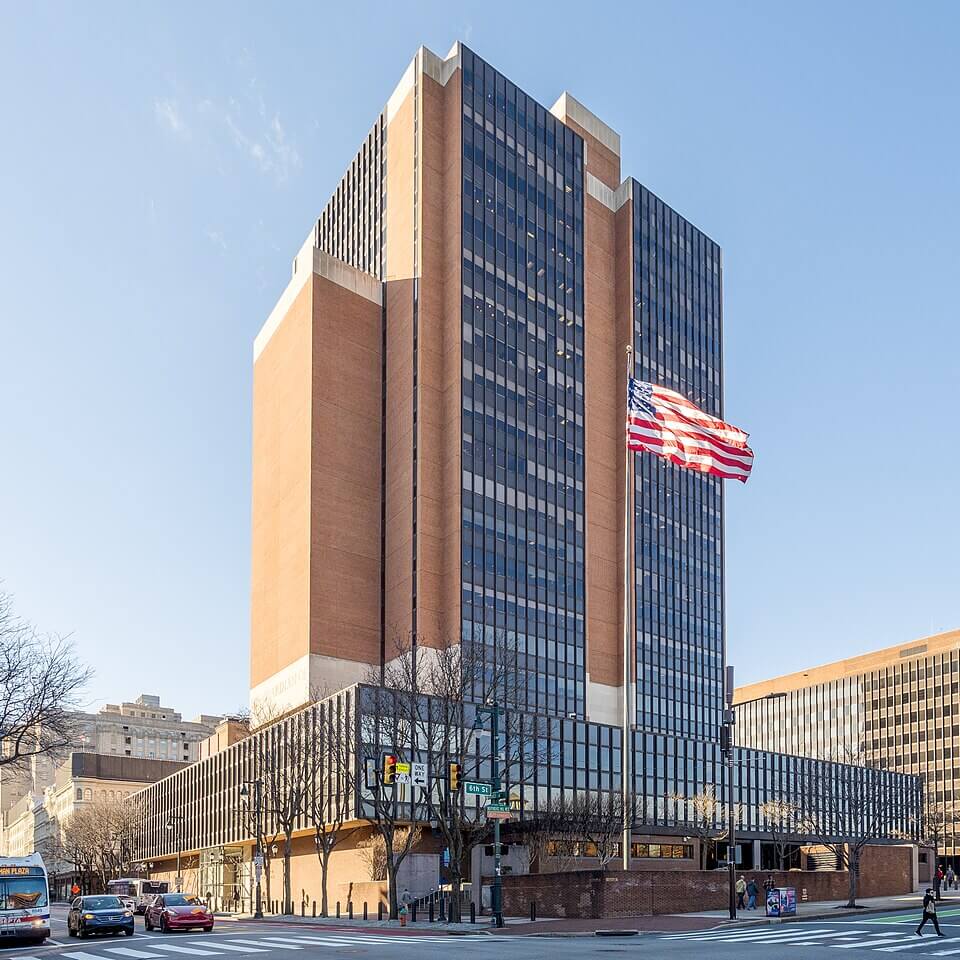
The Third Circuit's 2-1 ruling in KalshiEX LLC v. Flaherty, No. 25-1922, issued April 6, 2026, is the most significant judicial development in US prediction market history. Written by Judge David J. Porter and joined by Chief Judge Michael A. Chagares, it is the first federal appellate ruling to hold that the CEA pre-empts state gambling enforcement as applied to sports-related event contracts on a CFTC-licensed DCM. The decision is binding on federal courts in New Jersey, Pennsylvania, and Delaware.
| Question | Majority's answer |
|---|---|
| Are sports event contracts "swaps" under the CEA? | Yes — they fall within the CEA's definition of swaps as contracts whose value depends on the occurrence of an event. The majority rejected the argument that financial purpose is required for swap classification. |
| Does the CEA field-pre-empt state gambling law? | Yes — Congress granted the CFTC exclusive jurisdiction over swaps traded on DCMs. That exclusivity creates a federal regulatory field from which states are excluded. |
| Does the CEA conflict-pre-empt NJ enforcement? | Yes — it is physically impossible to comply with both the CFTC's authorisation to list these contracts and New Jersey's order to stop listing them. The state law must yield. |
Source: KalshiEX LLC v. Flaherty, No. 25-1922 (3d Cir. Apr. 6, 2026). Justia; Skadden client memo, April 9, 2026; Paul Weiss / CLS Blue Sky Blog, April 12–13, 2026.
The ruling's immediate practical effect is that New Jersey cannot enforce its gambling statutes against Kalshi's DCM-listed sports contracts. The decision also carries significant implications for Pennsylvania and Delaware, which fall within the Third Circuit's jurisdiction. Our Pennsylvania state guide tracks the current regulatory status; Pennsylvania is a Caesars Palace licensed market where a Kalshi enforcement action was not previously a primary concern, but the Third Circuit binding precedent provides additional clarity on the federal pre-emption question for any future state action there.
New Jersey has the option to petition for rehearing en banc before the full Third Circuit, a deadline that, per Holland & Knight's analysis, falls in approximately late May 2026. The 2-1 split and the federalism implications of the ruling provide plausible grounds for en banc review, though such petitions are rarely granted. If denied, New Jersey would need to petition the Supreme Court directly.
Sources: KalshiEX LLC v. Flaherty, No. 25-1922 (3d Cir. Apr. 6, 2026); Holland & Knight alert, April 7, 2026 — hklaw.com; Lowenstein Sandler client alert, April 20, 2026; Courthouse News Service, April 6, 2026.
The Roth Dissent — The Argument States Will Keep Pressing
Judge Jane R. Roth's dissent deserves close attention, because it is not merely a losing argument in the Third Circuit. It is the framework that the Ninth Circuit, the Fourth Circuit, and any future Supreme Court majority opposed to pre-emption will almost certainly reach for. Roth went to Kalshi's website and looked at the sports contracts directly. She found that on January 3, 2026, she could have traded on the Carolina Panthers vs. Tampa Bay Buccaneers game outcome, on a point spread, and on a player proposition bet for a specific receiver's touchdown.
Her conclusion was stated without equivocation: Kalshi's offerings are "virtually indistinguishable from the betting products available on online sportsbooks, such as DraftKings and FanDuel." She described the majority's reasoning as "a performative sleight meant to obscure the reality that Kalshi's products are sports gambling." The core of her technical objection was that DCM trading constitutes a "subfield" of futures trading too narrow to support field pre-emption of all state gambling law, and that the CEA's own savings clauses, which preserve some state authority, are fundamentally incompatible with the majority's complete pre-emption holding.
The Rule 40.11 paradox is the strongest technical argument available to states, and it is the one argument the majority in the Third Circuit did not fully resolve. Roth's framing, that the CFTC's own prohibition on gaming contracts undermines the conflict pre-emption holding, since an agency cannot claim exclusive jurisdiction over activity its own rules prohibit, is the logic that will be tested in every remaining circuit.
Sources: KalshiEX LLC v. Flaherty, No. 25-1922 (3d Cir. Apr. 6, 2026), Roth J. dissenting; Courthouse News Service, April 6, 2026; Sportico, April 8, 2026; Holland & Knight alert, April 7, 2026 — hklaw.com.
The Ninth Circuit — Nevada (April 16, 2026)
Oral arguments in the consolidated Nevada appeals, KalshiEX, North American Derivatives Exchange (Crypto.com), and Robinhood against Nevada, were heard on April 16, 2026, ten days after the Third Circuit ruling. The three-judge panel, composed of Judges Ryan D. Nelson, Bridget Bade, and Kenneth Lee, all appointed during the first Trump administration, appeared substantially more sympathetic to Nevada's position than the Third Circuit majority had been to New Jersey's.
The panel's questioning focused on three issues. First, whether the way prices are arrived at on an exchange constitutes a meaningful legal distinction from a sports wager placed at a licensed sportsbook, the panel appeared unconvinced it does. Second, whether Congress clearly intended the CEA to override state sports betting laws when it enacted the swap provisions, the panel focused on whether that intent was explicit enough to satisfy the strong presumption against pre-emption in areas of traditional state authority. Third, and most acutely, the Rule 40.11 problem: the panel pressed the CFTC's own counsel on why the commission's rule prohibiting gaming contracts on DCMs did not itself demonstrate that Kalshi's self-certifications were improper.
The CFTC argued for a split-track framework in which on-exchange transactions are regulated by the CFTC and off-exchange gambling remains state territory. The panel was not fully persuaded and pressed the CFTC on why Rule 40.11 did not constitute a prohibition rather than a passive certification pathway. Rob Schwartz, former CFTC General Counsel, observed on the day of arguments that the presiding judge appeared "as prepared a judge as I've seen", and that one of the exchanges had drawn the response "That can't be a serious argument" from the bench.
Sources: Gambling Insider, April 18, 2026 — gamblinginsider.com; Prediction News, April 16, 2026 — predictionnews.com; Nevada Current, April 16, 2026 — nevadacurrent.com; DeFi Rate, April 17, 2026 — defirate.com.
The Fourth Circuit — Maryland (May 7, 2026)
The Fourth Circuit heard arguments in KalshiEX LLC v. John Martin (No. 25-1892) on May 7, 2026, with Kalshi appealing Judge Abelson's August 2025 refusal to issue a preliminary injunction against Maryland enforcement. Neal Katyal, former Solicitor General of the United States, argued for Kalshi. The panel signalled significant reservations.
Judge Roger Gregory's comment from the bench captured the panel's posture precisely. According to reporting by the Baltimore Sun: "If it quacks, you know, it's a duck, right? It's gambling." The Law.com headline from the same day, "'Basically Gambling'?: 4th Circuit Questions Kalshi's Anti-State-Regulation Claim", reflects a panel that, while willing to hear the technical arguments, was not instinctively persuaded that the exchange structure transforms a sports wager into something categorically different.
The panel raised concerns about the CFTC's passive self-certification process for listing new contracts, the mechanism by which Kalshi lists sports event contracts without requiring affirmative CFTC approval. Maryland's counsel argued that CFTC passive self-certification cannot constitute the kind of affirmative federal authorisation that would pre-empt a state's own gambling authority. The panel appeared receptive to this framing. Maryland's argument also noted that licensed sports betting operators in the state paid $89 million in taxes to Maryland in fiscal 2025, while Kalshi operated outside that licensing framework entirely.
Sources: CourtListener docket KalshiEX LLC v. John Martin, No. 25-1892 (4th Cir.); Baltimore Sun, May 7, 2026 — baltimoresun.com; Law.com, May 7, 2026; DeFi Rate, May 8, 2026 — defirate.com; Bloomberg Law, May 7, 2026.
The Fourth Circuit argument also overlapped with arguments before the Massachusetts Supreme Judicial Court the same week, where Kalshi faced similar state court scepticism on the same pre-emption question. The week of May 5-8, 2026 was the most concentrated period of simultaneous multi-forum argument the case has produced.
The Sixth Circuit — Ohio and Tennessee
The Sixth Circuit, which covers Ohio, Michigan, Tennessee, and Kentucky, presents the most complex internal picture. Two district courts within the same circuit have reached opposite conclusions on the pre-emption question, creating a conflict that the Sixth Circuit itself will have to resolve.
In Ohio, the Southern District ruled against Kalshi in KalshiEX LLC v. Schuler (No. 2:25-cv-01165, March 9, 2026), finding that sports event contracts are not swaps within the CFTC's exclusive jurisdiction and that, in the alternative, the CEA does not pre-empt Ohio's gambling laws even if they were. The Sixth Circuit denied Kalshi's request for an expedited injunction in Ohio and is understood to be expediting the appeal itself.
Tennessee produced the opposite outcome at district level, with a court ruling for Kalshi on the pre-emption question. A federal injunction blocked Tennessee's enforcement action, meaning Kalshi has remained accessible in Tennessee while Ohio enforcement has been active. The Sixth Circuit will need to resolve this internal district-level conflict before or after any Supreme Court action, depending on the timeline.
Sources: KalshiEX LLC v. Schuler, No. 2:25-cv-01165, 2026 WL 657004 (S.D. Ohio Mar. 9, 2026); Paul Weiss / CLS Blue Sky Blog, April 13, 2026 — clsbluesky.law.columbia.edu; Bettors Insider analysis, April 2026; DeFi Rate, May 8, 2026.
What a Circuit Split Means — and the Path to the Supreme Court
A circuit split exists when two or more federal circuits reach different conclusions on the same legal question. The Third Circuit has already ruled for Kalshi. If the Ninth Circuit or Fourth Circuit rules against Kalshi, a formal circuit split is established: federal law means different things on different sides of a jurisdictional boundary, creating precisely the kind of legal inconsistency the Supreme Court exists to resolve.
| Circuit | Case | Status | Signal |
|---|---|---|---|
| Third (NJ) | KalshiEX v. Flaherty | Ruled Apr 6, 2026 | FOR Kalshi — 2-1. Field + conflict preemption. Binding in NJ, PA, DE. |
| Ninth (NV) | Consolidated NV appeals | Argued Apr 16, 2026. Ruling pending (60–120 days). | Panel appeared to lean toward Nevada. Sceptical on swap classification and Rule 40.11. |
| Fourth (MD) | KalshiEX v. Martin | Argued May 7, 2026. Ruling pending. | Panel openly sceptical. "If it quacks, it's a duck." Raised passive self-certification concerns. |
| Sixth (OH/TN) | KalshiEX v. Schuler (OH) + TN | Ohio expedited to Sixth Circuit. TN injunction in Kalshi's favour. | Split at district level. Sixth Circuit has not yet ruled on appeal. Internal circuit conflict to resolve. |
Sources: Court dockets; Paul Weiss / CLS Blue Sky Blog, April 13, 2026; Lines.com US prediction market legal status guide, April 2026; Holland & Knight, April 7, 2026.
The CFTC's separate suits against Arizona, Connecticut, and Illinois, filed April 2, 2026, add further parallel tracks. The commission characterised those suits as seeking to "prevent the enforcement of state laws that undermine the federal regulatory framework Congress established." Whether those cases are consolidated with the circuit-level appeals for Supreme Court purposes, or travel independently, will depend on the pace and outcomes of the pending circuit rulings.
Source: CFTC press release 9206-26, April 2, 2026 — cftc.gov.
The Two Possible SCOTUS Outcomes — and What They Mean
If the Supreme Court takes this case, it will resolve a question with structural consequences for the entire US gambling industry — not just prediction markets. The two possible outcomes operate on different timescales and affect different stakeholders.
| Outcome | For Kalshi / prediction markets | For states and licensed operators |
|---|---|---|
| Court affirms preemption — Third Circuit prevails | National access confirmed. CFTC licensing replaces state-by-state compliance. Operational certainty in all 50 states. | State gambling authority over CFTC-registered DCMs is extinguished. DraftKings and FanDuel lose the licensing exclusivity they built since 2018. Significant commercial disruption. Tax revenue impact in sports betting states. |
| Court rejects preemption — state authority upheld | Kalshi must obtain state licensing in each jurisdiction — or exit markets where licensing is unavailable. Sports event contracts may be unviable in most states without legislative action. | State gambling authority confirmed. Licensed operators' competitive position protected. Each state retains control over prediction market entry. |
There is a third track that could render the litigation moot before the Supreme Court acts: Congress. The Prediction Markets Are Gambling Act, introduced by Senators John Curtis (R-Utah) and Adam Schiff (D-Calif.) on March 23, 2026, would amend the CEA to reclassify sports and casino-style event contracts as gambling outside CFTC jurisdiction. If enacted, it would resolve the pre-emption question by removing prediction market sports contracts from the CEA framework entirely. The bill's prospects are uncertain; it has bipartisan sponsorship but faces opposition from both the Trump administration and the prediction market industry.
Source: Holland & Knight alert, April 7, 2026 — hklaw.com; Norton Rose Fulbright analysis, April 23, 2026.
Related Intelligence
Stay Informed
The Ninth and Fourth Circuit rulings in this case are expected within the next 60 to 120 days. The Wager Layer newsletter tracks court developments, enforcement actions, and regulatory changes across prediction markets and sweepstakes casinos as they happen.
Subscribe — Wager Layer Newsletter
Change Log
| Date | Change | Detail |
|---|---|---|
| May 2026 | Article published | Initial publication. Covers Third Circuit ruling (Apr 6), Ninth Circuit arguments (Apr 16), Fourth Circuit arguments (May 7), Sixth Circuit district split, and SCOTUS certiorari analysis. Ninth and Fourth rulings pending. |
This article is provided for informational purposes only and does not constitute legal advice. All litigation described is active and subject to change. The analysis of judicial signals from oral argument does not predict outcomes. Users seeking legal advice regarding access to prediction market platforms should consult qualified legal counsel. Last reviewed: May 2026.