
After the Ninth Circuit's Stay Denials: Kalshi's State-by-State Legal Map, Explained
Kalshi won a landmark Third Circuit ruling in April. Then the Ninth Circuit denied its stay requests in May. The same platform is simultaneously winning and losing depending on geography, and the CFTC's pending rulemaking sits on the fault line between both outcomes.
- ›On May 22, 2026, the Ninth Circuit denied stay requests from Kalshi and Polymarket, enabling Nevada and Washington state enforcement to proceed.
- ›The Third Circuit ruled for Kalshi on April 6 (New Jersey case). The Ninth Circuit's stay denials effectively strand that win in a single circuit.
- ›At least nine states have issued cease-and-desist letters or filed lawsuits against Kalshi or Polymarket. The platform's operational status varies sharply by jurisdiction.
- ›The CFTC's pending Advance Notice of Proposed Rulemaking (91 Fed. Reg. 12516, March 2026) sits directly on the preemption question both the Third and Ninth Circuits are deciding.
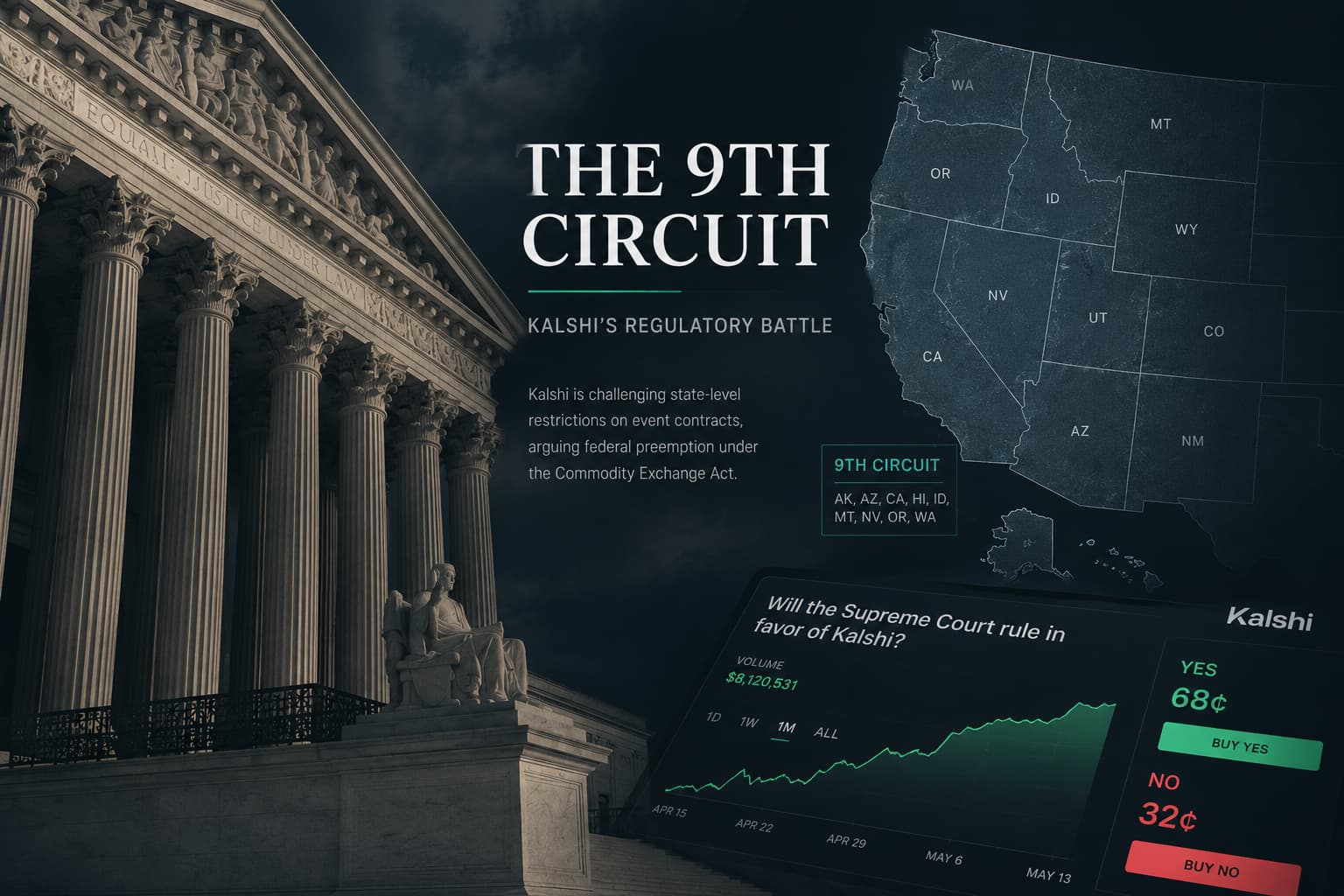
- ›Prediction market traders assign a 64% probability to SCOTUS accepting a sports event contract case by end of 2026.
What the May 22 Stay Denials Actually Did
On May 22, 2026, the Ninth Circuit Court of Appeals denied stay requests from both Kalshi and Polymarket, allowing state-level enforcement actions in Nevada and Washington to proceed while the broader merits of the federal preemption question remain unresolved. The court found the platforms' federal preemption arguments unconvincing as a basis for emergency relief, rejecting the claim that they would suffer irreparable harm if enforcement continued.
A stay denial is procedurally distinct from a ruling on the merits. The Ninth Circuit has not yet issued its final decision on whether CFTC jurisdiction preempts Nevada's enforcement authority over Kalshi's sports event contracts. The stay denial means that the court, at this stage, is not persuaded that the federal preemption argument is strong enough to halt state enforcement while that underlying question is litigated. That is a meaningful signal, though not a final determination.
The stay denials are significant precisely because of the timing. The Third Circuit's ruling in Kalshi's favor (April 6, 2026, in KalshiEX LLC v. Flaherty, No. 25-1922) established that federal swap law preempts New Jersey's gambling regulations as applied to sports event contracts. That ruling gave Kalshi a viable preemption argument. But the Ninth Circuit's May 22 orders demonstrate that the same argument, in the Ninth Circuit, is not sufficient to obtain interim relief. As one legal analysis noted, the Third Circuit win does not soften the Ninth Circuit denials; it raises their cost, by showing precisely what Kalshi loses when the federal preemption theory cannot be reached.
Sources: Value the Markets, "Ninth Circuit Ruling Impacts Prediction Markets," May 2026; MCAI Lex Vision, "Kalshi, the Ninth Circuit, and the Prediction Markets Forum Fight," May 2026; Holland & Knight, "Federal Appeals Court: CFTC Jurisdiction Over Sports Event Contracts Likely Exclusive," April 7, 2026.
The State-by-State Operational Map
As of June 2026, Kalshi's ability to operate varies significantly depending on geography and the applicable federal circuit. The following represents our analysis of publicly reported enforcement actions, court filings, and platform status based on available sources. It is not a complete legal assessment of Kalshi's status in any jurisdiction.
| State / Jurisdiction | Circuit | Status as of June 2026 | Key action |
|---|---|---|---|
| New Jersey | 3rd | Protected | Third Circuit affirmed preliminary injunction 2-1, April 6, 2026. Preemption argument prevailed. |
| Nevada | 9th | Blocked | NGCB cease-and-desist March 2025. District court ruled against Kalshi Nov 2025. Ninth Circuit denied stay May 22, 2026. |
| Washington | 9th | Blocked | AG filed suit March 2026. Ninth Circuit denied stay May 22, 2026 alongside Nevada. |
| Maryland | 4th | Pending | Fourth Circuit heard oral arguments May 7, 2026 in KalshiEX v. Martin, No. 25-1892. Ruling pending. |
| Arizona | 9th | Enforcement | CFTC v. Arizona (CFTC PR 9208-26). Criminal charges filed by AZ AG against Kalshi. |
| Illinois | 7th | Pending | CFTC + DOJ v. Illinois (Case 1:26-cv-03659). Federal preemption case ongoing. Illinois state guide updated when ruling issues. |
| Minnesota | 8th | Blocked | SF4760 signed May 18, 2026. Felony effective August 1. CFTC v. Minnesota filed May 19. Injunction pending. |
Sources: Lines.com, "U.S. Prediction Market Legal Status 2026," April 23, 2026; Bettors Insider, "The Kalshi Legal Battle Is Heading Toward the Supreme Court," April 20, 2026; Value the Markets, May 2026; Wager Layer live regulatory tracking.
The pattern that emerges is a platform that holds strong federal preemption arguments in theory, with those arguments having won in the Third Circuit, but that cannot convert those arguments into interim protection in the Ninth Circuit, where enforcement is already proceeding. For Kalshi users in Nevada and Washington, the practical result is that sports event contracts are unavailable while the appeal on the underlying merits continues.
For Kalshi's full T&C analysis and risk score, see our complete Kalshi platform analysis. For Nevada's regulatory context, see our Nevada online gambling state guide.
The CFTC Rulemaking Sitting on the Fault Line
The most underreported element of the current litigation landscape is the CFTC's Advance Notice of Proposed Rulemaking on prediction markets, published at 91 Fed. Reg. 12516 in March 2026. The CFTC has not yet taken a definitive regulatory position on whether sports event contracts are permissible under its existing rules. That gap is central to both the Third Circuit's reasoning in Kalshi's favor and the Ninth Circuit's skepticism of Kalshi's stay requests.
The Third Circuit's Flaherty majority leaned partly on the CFTC's non-action: the agency had not moved to prohibit sports event contracts under Rule 40.11, which the majority read as implicit toleration. The dissent, written by Judge Jane Richards Roth, pointed to the same rule's text as an existing prohibition. Both positions are tenable precisely because the CFTC has not issued definitive guidance. If the agency uses the pending ANPR to formally permit sports event contracts, the preemption case for platforms like Kalshi becomes substantially stronger across all circuits. If it moves in the other direction, the opposite follows.
The current administration has expressed support for CFTC jurisdiction over prediction markets. The CFTC filed an amicus brief asserting exclusive jurisdiction in the Ninth Circuit proceedings. That filing did not produce a stay, which suggests the Ninth Circuit panel was not persuaded that the agency's amicus position, without a formal rule, constitutes the kind of definitive federal preemption that justifies halting state enforcement.
Source: Holland & Knight, "Federal Appeals Court: CFTC Jurisdiction Over Sports Event Contracts Likely Exclusive," April 7, 2026; MCAI Lex Vision, "Kalshi, the Ninth Circuit, and the Prediction Markets Forum Fight," May 2026.
The Institutional Inversion Problem
Reuters reported in late May 2026 that Clear Street became the first institutional Futures Commission Merchant to join Kalshi's exchange and clearing house, with Marex building infrastructure connecting investors to both Kalshi and Polymarket, and Jump Trading beginning to route institutional flow toward the venues. This institutional build-out creates an unexpected legal tension.
Kalshi's legal strategy depends on characterising its contracts as federally regulated derivatives under the Commodity Exchange Act, a characterisation that the Third Circuit accepted and that supports the preemption argument. But as the platforms attract prime brokers, clearing infrastructure, and institutional market makers, the derivative characterisation becomes harder to separate from the state gambling characterisation. States argue that contracts tied to sports outcomes are sports betting regardless of how the infrastructure is structured. The growth of derivative-style infrastructure around these contracts arguably makes that argument easier to sustain, not harder.
Source: MCAI Market Vision, "Kalshi's Institutional Push Is Building the Case Against Itself," May 2026 (Reuters cited within); Wager Layer, Kalshi platform analysis (v1.6 member agreement).
The Path to SCOTUS
Prediction market traders currently assign a 64% probability to SCOTUS accepting a sports event contract case by end of 2026, according to market pricing reported by Bettors Insider. The circuit split that would trigger Supreme Court review is not yet formally confirmed: the Third Circuit has ruled for Kalshi; the Ninth Circuit has not yet issued its final merits ruling. When the Ninth Circuit does rule, a decision against Kalshi would create an explicit circuit split on the core preemption question, at which point Supreme Court review becomes likely. A decision for Kalshi would not necessarily resolve the broader national picture, given the number of states still pursuing enforcement in multiple circuits.
The Fourth Circuit's ruling in KalshiEX v. Martin (No. 25-1892), with oral arguments heard May 7, 2026, adds a third data point. If the Fourth Circuit rules against Kalshi, the split will span three circuits and three jurisdictions. The Supreme Court generally grants certiorari when circuit splits involve questions of significant federal law, and the scope of federal preemption under the Commodity Exchange Act clearly qualifies. Based on the oral argument reports from both the Ninth and Fourth Circuits, the appellate panels in those cases appeared skeptical of Kalshi's federal preemption arguments, making an adverse ruling in one or both more likely than not.
Sources: Bettors Insider, "The Kalshi Legal Battle Is Heading Toward the Supreme Court," April 20, 2026; Fortune, "Kalshi's Fight Over Prediction Markets Sports Betting Moves Toward the Supreme Court," April 20, 2026; Holland & Knight, "Federal Appeals Court," April 7, 2026.
For Kalshi Users: What This Means Now
The practical impact on Kalshi users depends entirely on their state of residence. In New Jersey, the Third Circuit's ruling means the platform has court-backed protection against state enforcement. In Nevada and Washington, state enforcement is proceeding and Kalshi cannot currently offer sports event contracts. In Minnesota, a felony-level ban is effective August 1, 2026, and the CFTC's preemption lawsuit against the state is pending.
Users in states with pending litigation face an uncertain period. Arizona has taken the most aggressive position, pursuing criminal charges in addition to civil enforcement. Our full assessment of Kalshi's regulatory standing, contract terms, and risk score is available in our Kalshi platform analysis, which we update as material rulings are issued.
See our full Kalshi T&C analysis and risk score for platform-level assessment. See the Nevada online gambling guide and Arizona online gambling guide for state-level context.
The Ninth Circuit and Fourth Circuit rulings on Kalshi will reshape the prediction market landscape. Subscribe to Wager Layer's regulatory intelligence newsletter for analysis when they land.
Subscribe to the newsletter →
| Date | Change |
|---|---|
| June 2026 | Article published. Covers Ninth Circuit stay denials of May 22, 2026 and Kalshi's state-by-state operational map. Pending: Ninth Circuit merits ruling; Fourth Circuit ruling in KalshiEX v. Martin. |